
What are robot dogs used for in security? A practical guide
OVER Editorial · Updated November 19, 2026 · Blog
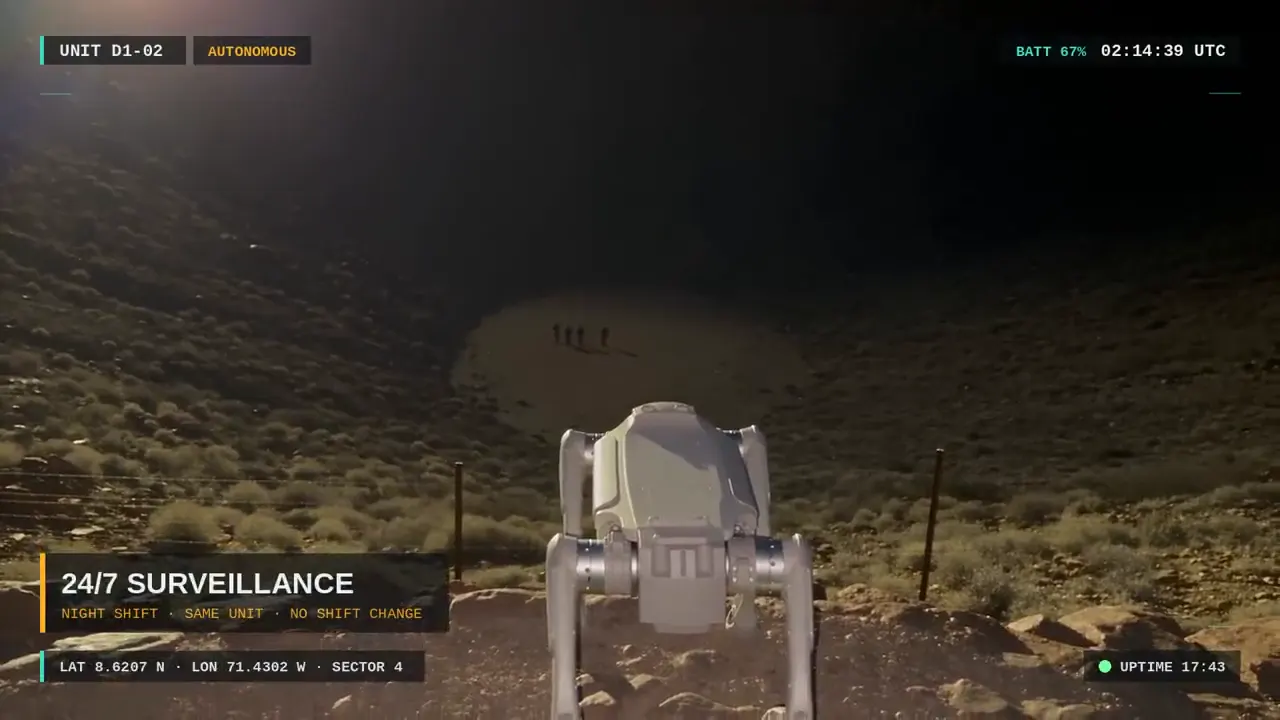
What are robot dogs used for in security? Mostly for the rounds nobody wants to walk: night patrols, fence lines, plant rooms and yards where a fixed camera cannot see everything. This guide is for security managers, facility managers and operations leads who want to know what a quadruped robot can really do on their site before they ask for a quote.
You will find the tasks robot dogs take on, where they add value next to fixed cameras, how guards work with them, what drives the cost and how to run a first pilot.
Key takeaways
- Robot dogs take repeatable patrols and checks, not the human judgment.
- They add value where fixed cameras leave gaps: large, changing or cluttered areas.
- The guard stays in charge: orders, alerts, response and emergency stop.
- Cost depends on site factors, so a pilot on one site comes first.
- Ask where the AI runs and where your video and maps are stored.
What tasks can a security robot dog do on patrol?
Security robot dogs mostly run repeatable patrols: walking fixed or random routes, checking doors, gates and fences, reading gauges, spotting people or vehicles where they should not be, and streaming live video to an operator. They also give spoken warnings and log every event with time and position, so a guard can verify and respond.
In practice, the tasks fall into four groups:
- Patrol. Scheduled or random rounds, inside and outside buildings.
- Check. Doors closed, gates locked, fences intact, lights on.
- Detect and warn. Intruders after hours, spoken notices, alert to the control room.
- Document. Photos and video tagged with time and place for incident reports.
Four legs matter because real sites are not flat. A quadruped handles curbs, gravel, ramps and cluttered floors better than a wheeled robot. Typical settings are construction sites, warehouses, infrastructure sites and industrial plants.
Where do robot dogs work better than fixed cameras?
Robot dogs work better than fixed cameras where the area is large, changes often or has blind spots: construction sites, yards, plant rooms, parking lots and long fences. Fixed cameras watch one view all the time with little upkeep. A robot moves its camera to where the question is and can check things a camera cannot see.
This is not a replacement story. Fixed cameras are cheap to run, always on and well understood by insurers and auditors. A good plan keeps them and sends the robot where they are weak:
- Areas that change every week, like a building site.
- Spots behind racks, containers or machinery.
- Checks that need a close look: a door handle, a seal, a gauge.
- Alarms that need verification before a guard drives across the site.
A simple test: list the last ten alerts that sent a guard out. If most of them only needed someone to go and look, a robot can likely take that first look.
How do security guards and robot dogs work together?
Guards and robot dogs work best as one team: the robot takes the repetitive rounds, night walks and checks in unpleasant areas, while guards handle people, judgment and physical response. The guard gives the order in plain words, watches the live video, decides on each alert and goes on site when something needs a human.
A typical night shift with a robot looks like this:
- The supervisor schedules the rounds and any extra checks.
- The robot patrols and reports events to the dashboard.
- The guard reviews each event on live video and decides.
- If needed, the guard goes on site, already knowing what to expect.
- The shift ends with a log of rounds, events and footage.
Two rules keep the team safe. The guard can stop the robot at any time, and every action the robot takes is checked against site rules first. Ask any vendor to show you both in a live demo.
How much does a security robot dog cost?
The cost of a security robot dog depends on the site, not only on the robot. The main factors are the area and terrain to cover, the number of robots and patrol hours, mapping, the on-site computing, integration with your alarm and video systems, data retention and support. A pilot on one site turns these into a real quote.
The factors that move the number most:
- Site. Square meters, indoor or outdoor, stairs, weather exposure.
- Coverage. Hours per night, rounds per hour, number of robots.
- Mapping. Who builds the site map and how often it is updated.
- Computing. Cloud service or a server inside your perimeter.
- Integration. Alarm panels, video management, access control.
- Data. How long you keep video and photos, and where.
Be careful with comparisons to guard hours. A robot does not replace the guard who responds, so compare the full patrol model, not one line item.
How to run a robot dog pilot in 5 steps
- Pick one site and one problem. For example, night fence checks or after-hours intrusions in one building.
- Write the baseline. Rounds done today, alerts per week, how many needed a guard on site.
- Map the site and set the routes. Agree on patrol areas, no-go zones and where the robot charges.
- Run it with your team. Guards give the orders, review alerts and log what the robot missed or caught.
- Measure and decide. Compare rounds completed, alerts verified remotely, false alarms and guard feedback against the baseline.
Questions to ask any vendor before you start:
- Does positioning depend on GPS, Wi-Fi or tags on the walls?
- Where do the AI models run, and does the robot work offline?
- Who can stop the robot, and how?
- How long is video stored, and who sets that period?
- Is face recognition on by default, and can you switch it off?
How OVER approaches security patrols
OVER software drives a Unitree Go2 quadruped and a Booster T1 humanoid. The same software covers quadruped and humanoid robots for security patrols, inspection, commercial buildings and infrastructure. Operators write orders in plain words, in any language, in a chat on the dashboard, and a vision-language model turns each order into robot actions.
A rule-based safety layer checks each action before it starts, and the robot gives spoken notices in any language. Positioning works without GPS: your site is walked once with a 360° camera and becomes a metric 3D map, then the robot localizes from its own camera images with our visual positioning system, indoors and outdoors, with no beacons, tags or markers.
Language and perception models run on a GPU server inside your perimeter, with no mandatory cloud service, so images and maps stay on site. One dashboard shows the whole fleet, stores photos and video with time and position for the period you set, and keeps the emergency stop always available to operators. Projects start with a pilot of about 90 days on one site. To plan your pilot, see our security robots page and talk to our team.
FAQ
Can robot dogs patrol at night?
Yes. Night rounds are one of the main reasons security teams test them. The robot follows its routes in the dark while the guard reviews events from the control room.
Do security robot dogs need GPS?
Not necessarily: camera-based positioning against a 3D map works without GPS, indoors and outdoors. Some systems still rely on GPS outside, but it is not available inside buildings.
Are security robot dogs legal around people?
It depends on where you operate. Video, audio and face recognition usually fall under privacy and workplace law. Check the rules with your legal team before the pilot and set retention periods in writing.
Do robot dogs replace security guards?
No. They take repetitive rounds and first checks. Guards still decide on alerts, deal with people and respond on site.