
Visual positioning system API for enterprise apps
Visual positioning system API that returns the position and orientation of a phone camera in under 100 ms, with centimeter-level accuracy, indoors and outdoors. Use it in your own app or web experience.
Already a customer? Log in
- Input
- camera image + 3D map
- Output
- 6DoF pose: position and orientation
- Relocalization
- under 100 ms
- Accuracy
- centimeter-level
- Runs in
- iOS Safari, Android Chrome, native apps
- Maps
- 270,000+ locations on the OVER platform
What is a visual positioning system?
A visual positioning system (VPS) finds where a camera is and which way it points by comparing the image with a 3D map of the place. Unlike GPS it works indoors and is precise enough to anchor AR content to a wall or a shelf. OVER’s VPS runs on 270,000+ mapped locations.
Walk the venue
Capture the indoor or outdoor space with a 360° camera or smartphone.
Reconstruct & anchor
Our pipeline builds the 3D point cloud and digital twin for localization.
Relocalize in < 100 ms
Any camera frame returns an exact 6DoF pose against the 3D map.
How accurate is 6DoF camera localization indoors?
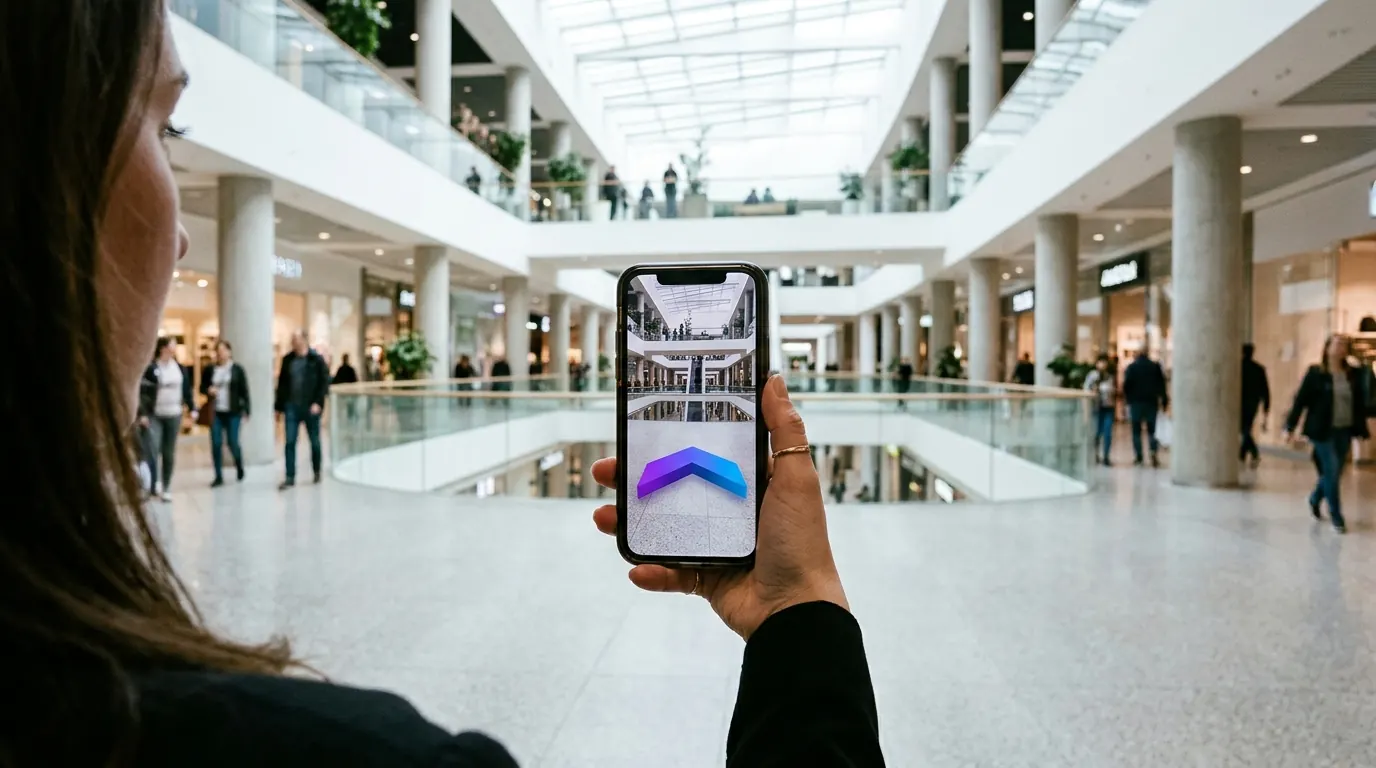
OVER’s camera localization returns a full 6DoF pose, position and orientation, with centimeter-level accuracy, and relocalizes in under 100 ms. That is what keeps AR arrows on the floor while a visitor walks through a 150,000 m² mall like Città Fiera. Accuracy depends on the quality of the 3D map, which we build for you.
What you get
- REST API. Send a camera frame, get back a 6DoF pose.
- Unity and WebAR SDKs. For native apps and browser experiences.
- 270,000+ mapped locations. Ready to localize against today.
- Your own venues. Mapped by us with a 360° camera and added to your maps.
VPS vs GPS: what changes in GPS-denied places?
GPS estimates position from satellite signals, which fade indoors, underground and between tall buildings. A visual positioning system works from the camera image and a 3D map, so it keeps working in GPS-denied places and returns orientation as well as position. Many apps use both: GPS for the rough area, VPS for centimeter-level placement.
Is OVER an 8th Wall alternative for VPS AR?
Yes, for teams that need hosted WebAR with positioning. The hosted 8th Wall platform closed in February 2026 and its open-source engine does not include VPS. OVER offers a visual positioning system with a web AR platform, so you can publish VPS AR experiences as a browser link, with no app.
What teams build with visual localization
Indoor navigation
AR wayfinding in malls, hospitals and airports.
OVER Wayfinding Suite →AR for brands and retail
Content anchored to stores, streets and products.
WebAR Builder →Robot localization
Position robots and devices in mapped sites.
Robotics & data →
Building for clients? Partner with us →
Questions buyers ask
Does it need GPS or beacons?
No. Localization uses the camera image and a 3D map. It works indoors, where GPS fails, and needs no hardware in the space.
Can you map our own sites?
Yes. We map venues with a 360° camera and add them to the maps your app can localize against.
What is the difference between VPS and SLAM?
SLAM tracks a device by building a local map as it moves, so each session starts from zero. A VPS localizes against a shared 3D map built in advance, so every device gets the same coordinates for the same place. AR and robot apps often use both: SLAM for smooth tracking, VPS for relocalization.
Can we anchor AR content to real places, like geospatial anchors?
Yes. Content is placed in the coordinates of the 3D map, so it appears in the same spot for every visitor. In the WebAR Builder these are VPS location anchors, published as a browser link.
Can robots and devices use it in GPS-denied sites?
Yes. Any camera frame from a mapped site returns a 6DoF pose, with no satellite signal or beacons needed. Teams use it to position robots and devices in warehouses, plants and other indoor sites.
Where is the technical documentation?
API and SDK documentation is on docs.overthereality.ai. Ask us for access to the enterprise endpoints.
Project scoping
Talk to us about the VPS API
A few clicks to tell us about your venue or project, then your contact details. Rough answers are fine.
What happens next
- 01Answer a few questions. Two short steps. Rough answers are fine.
- 02Our reply. We reply by email within 1 business day to set up a short scoping call.
What happens next
- 01Answer a few questions. Two short steps. Rough answers are fine.
- 02Our reply. We reply by email within 1 business day to set up a short scoping call.