
3D spatial data for robotics and VLN/VLA training
3D spatial data for robotics teams: we capture your sites, build metric sim-ready digital twins, and train VLN and VLA models and policies for humanoid, quadruped and mobile robots.
AI lab or research team looking to license our pre-collected global dataset? Explore OverMaps data licensing (171,635 scenes, 86M+ images, ~672 TB) →
Beyond data collection
Train VLN/VLA models and robot policies: VLA model training and robot learning in simulation
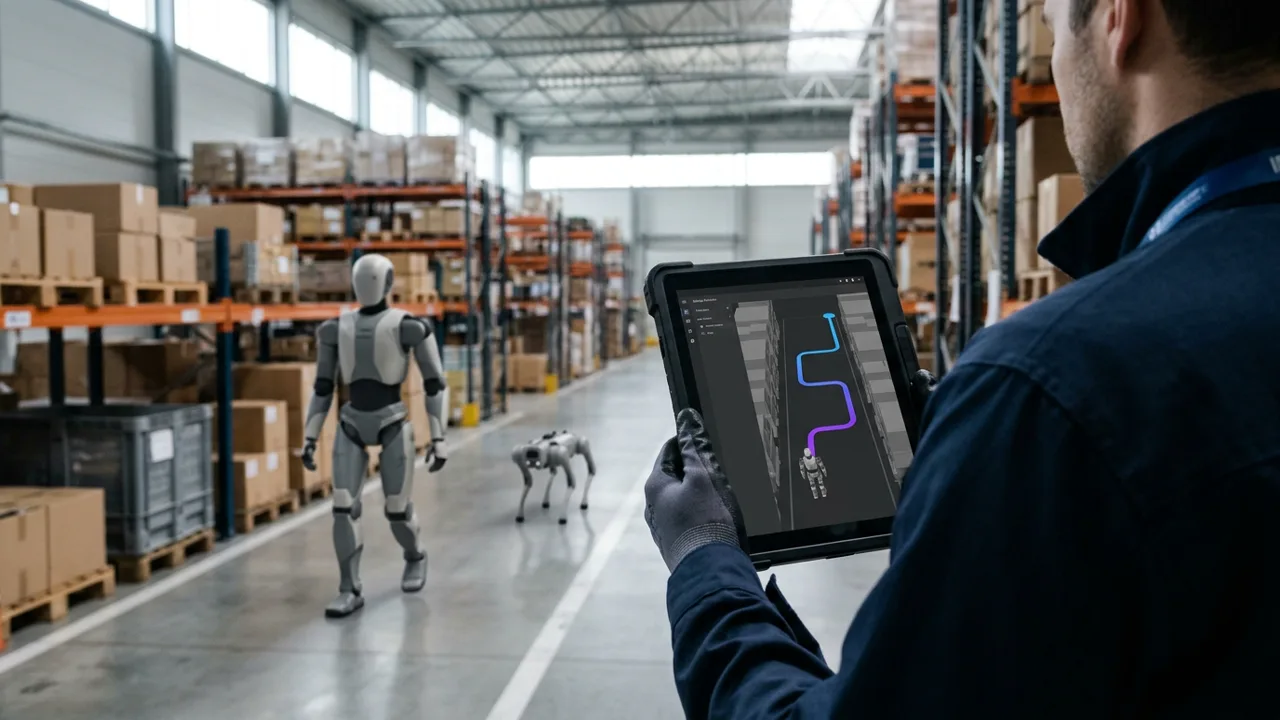
OVER does not stop at scanning. We train models and policies directly on the metric digital twins and spatial datasets of your sites, so humanoid robots, quadruped robot dogs and mobile robots learn on the exact aisles, stairs, doors and work zones where they will operate.
VLN (Vision-Language Navigation): the robot follows spoken or written natural-language instructions using camera vision to navigate real rooms and aisles.
VLA (Vision-Language-Action): the model turns camera video and a language prompt directly into physical robot actions, locomotion and manipulation.
- What we train
VLN, VLA & robot policies
Natural-language navigation (VLN), action and manipulation models (VLA), and locomotion or navigation policies.
- Which robots
Humanoids, quadrupeds & AMRs
Humanoid robots, quadruped robots (robot dogs), autonomous mobile robots (AMRs) and service robots.
- What we train on
Your site’s digital twin
Metric, sim-ready digital twins of your facilities, annotated spatial datasets and simulation scenarios.
- How we validate
Sim-to-real & field tests
Closed-loop evaluation in simulation followed by field validation and replication on your real site.
What is a VLA model (vision-language-action)?
A Vision-Language-Action (VLA) model takes camera images and a natural-language instruction and outputs direct robot actions, such as movement trajectories or manipulation commands. We train and fine-tune VLA models inside metric digital twins of your real facility, so the robot learns to act on your actual layout, objects and work zones before deployment.
What is vision-language navigation (VLN) and a VLN dataset?
Vision-Language Navigation (VLN) lets a robot follow spoken or written directions—such as “go to aisle four and inspect the main valve”—using what its cameras see. We build a site-specific VLN dataset from our 3D captures, pairing real visual routes with language instructions, and train navigation models on your facility’s digital twin.
How do you train a humanoid robot policy in simulation?
We load the metric digital twin of your plant, warehouse or office into the simulator, define the tasks and constraints, and train locomotion, navigation and manipulation policies across thousands of simulated runs. We then validate the trained policy on your real site, compare behavior, and feed real-world edge cases back into simulation.
Can you train navigation for quadruped robots and quadruped robot navigation policies?
Yes. Quadruped robots and robot dogs handle stairs, ramps, outdoor yards and uneven industrial floors where wheeled robots stop. We capture those areas in 3D, label traversable surfaces, stairs and hazards, and train quadruped robot navigation and inspection policies in simulation before validating the routes on your real site.
What does end-to-end data collection include?
Data collection is more than scanning. We capture the site, clean and anonymize the data, rebuild it as a metric digital twin, label it, export it in the formats your simulator accepts, and help you train and test models on it. The same loop then checks results back on the real site.
- 01
Capture
360° cameras, LiDAR or smartphones on production sites, offices and warehouses.
Details
Capture can run during normal operations. At Città Fiera one operator covered 150,000 m² in 90 minutes with a single 360° camera.
- 02
Pre-processing
Alignment, anonymization and cleaning of the raw data.
Details
People, screens and areas you mark as confidential are blurred or removed before the data moves on.
- 03
Reconstruction
A metric digital twin: point cloud and Gaussian splatting.
- 04
Annotation and labeling
Objects, surfaces, zones, instructions and paths labeled for your task.
- 05
Post-processing and export
Sim-ready formats and VLN/VLA datasets agreed with you at scoping.
- 06
Simulation
Sim-ready environments to train and test robot behavior.
- 07
Training and testing
VLN/VLA models and robot policies trained and evaluated on a copy of your real site.
- 08
Real-to-sim-to-real
Results checked back on the real site, then the loop repeats.
What is a sim-ready digital twin?
A sim-ready digital twin is a metric 3D copy of a real site that a robot simulator can load directly: correct scale, clean geometry, labeled objects and surfaces, and a format the simulator accepts. It lets teams train and test robot behavior on the place where the robot will actually work.
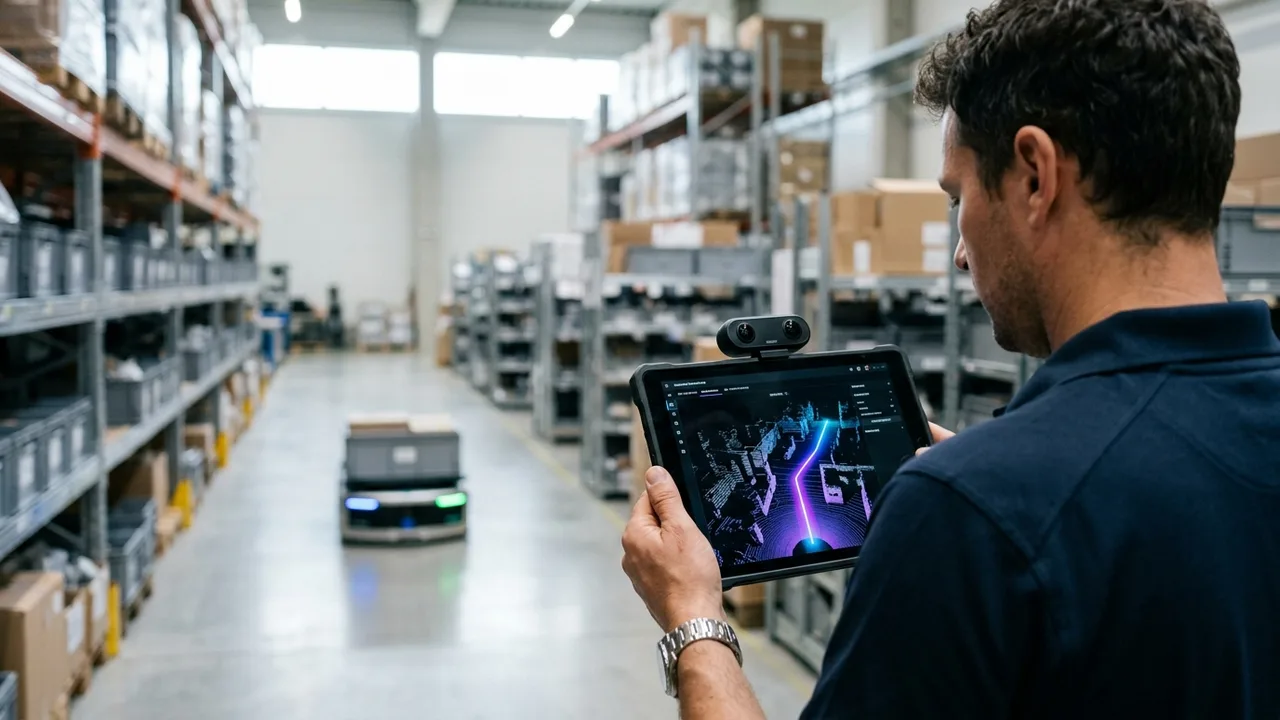
Metric 3D digital twin reconstructed from video
Dense point cloud and Gaussian splatting environment reconstructed from real site footage.
How do you collect humanoid robot training data and run humanoid robot policy training on a real site?
We walk the site with 360° cameras, LiDAR or phones, following the routes and tasks your robots will perform, during normal operations. The footage becomes a metric twin; we label what matters for the task and export scenes and sequences for training. Sensitive areas and people are anonymized before delivery.
Use cases we capture and train for
- Inspections. Rounds of gauges, panels and equipment, on the real layout.
- Assistance. Guiding visitors and staff, fetching items in offices and plants.
- Safety. Patrols, exits and restricted zones checked by robots.
- Material handling. Moving goods between lines, storage and loading bays.
What does real-to-sim-to-real mean?
Real-to-sim-to-real is a loop. You capture the real site, build a simulation from it, train and test the robot there, then deploy on the real site and compare. Differences go back into the next capture or simulation. Starting from real data shrinks the gap between how a robot behaves in simulation and on site.
What you receive
- Datasets & VLN/VLA episodes. Raw and processed captures, language-route pairs and action labels.
- Sim-ready digital twin. Metric point cloud, Gaussian splatting model and mesh.
- Trained VLN/VLA models & policies. Navigation and action policies trained and tested in simulation for humanoids, quadrupeds and AMRs.
- Validation report. Coverage, simulation benchmarks, field validation and anonymization log.
How we work
- 01
Scoping call
Your robots (humanoid, quadruped, AMR), tasks, sites and simulator.
- 02
Pilot area
One line, floor or aisle captured, reconstructed and trained end to end.
- 03
Delivery & validation
Datasets, twin, trained VLN/VLA policies and sim-to-real report.
- 04
Scale
More areas, tasks and sites with the same pipeline.
Where this comes from
- 270,000+ locations. mapped on the OVER platform worldwide.
- Large Geospatial Model. OVER’s model of the physical world, described on overthereality.ai.
- 150,000 m² in 90 minutes. captured with one 360° camera at Città Fiera.
- Industrial onboarding. We are onboarding the corporate and production site of a multinational industrial group.
Questions buyers ask
Do you only collect data, or do you also train VLN/VLA models and robot policies?
We do both. Beyond capturing your site and delivering sim-ready digital twins and labeled datasets, we train VLN (Vision-Language Navigation) and VLA (Vision-Language-Action) models and locomotion or navigation policies for humanoid robots, quadruped robot dogs and mobile robots, and validate them from simulation back to your real site.
Is our site data kept confidential?
Data is used only for your project, anonymized before delivery, and handled under the agreement we sign with you.
Which formats do you deliver?
Formats are agreed at scoping to match your simulator and tools. Point clouds, meshes, Gaussian splatting models, calibrated camera poses, VLN/VLA training episodes and trained policy checkpoints are typical outputs.
Can we start with one area?
Yes. Most projects start with a pilot area, such as one line, one floor or one warehouse aisle, before scaling to more sites.
Talk to our spatial data and robot training team
A few clicks to tell us about your venue or project, then your contact details. Rough answers are fine.