
Perimeter patrol robot: how to plan, run and measure a pilot
OVER Editorial · Updated November 14, 2026 · Blog
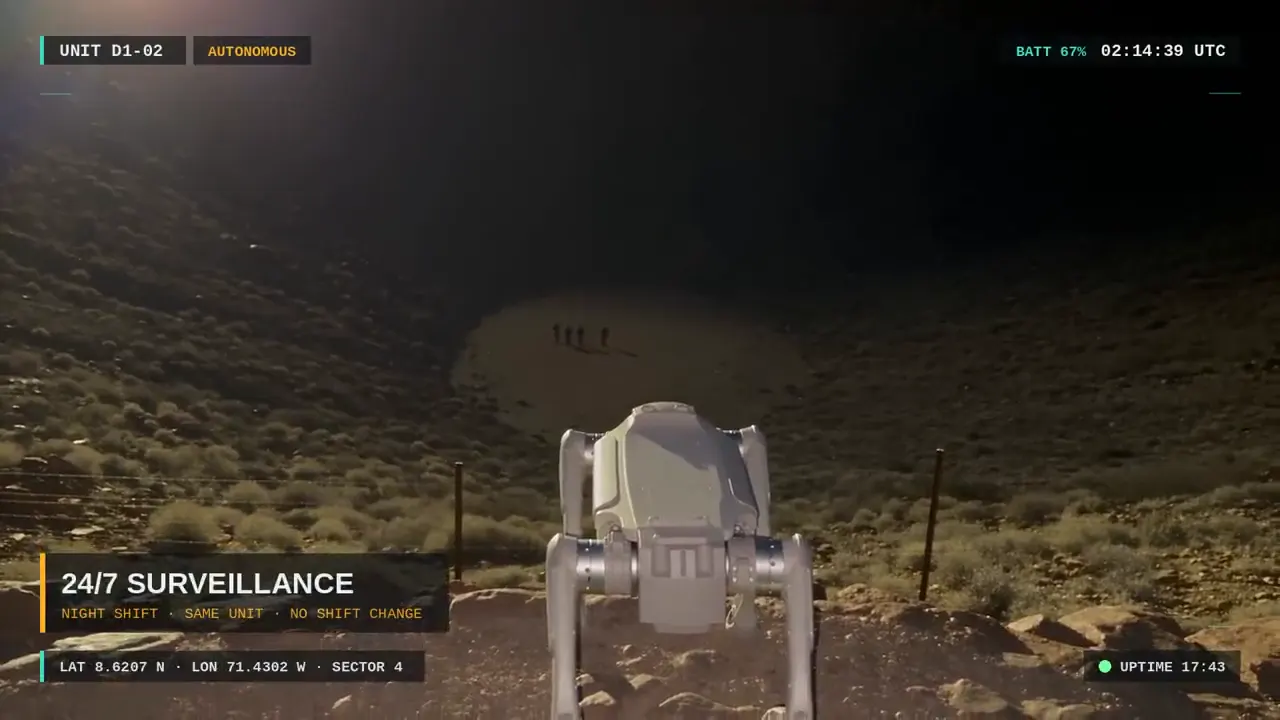
A perimeter patrol robot walks the fence line, gates and yards of a site on a planned round, streams what it sees to an operator and logs anything out of place. This guide is for security managers, facility managers and operations leads who are weighing a pilot on one industrial, logistics or infrastructure site.
You will find what these robots do, how they find their way without GPS, where the AI should run, and how to structure a pilot so the results support a clear decision.
Key takeaways:
- A patrol robot adds a moving, recorded camera to guards and fixed cameras.
- Positioning can work from camera images and a 3D map, without beacons or tags.
- On-premise AI keeps images and site maps inside your perimeter.
- Start with one site, a pilot of about 90 days and metrics agreed up front.
Where fixed cameras and guard rounds leave gaps
Most perimeters rely on three layers: fences and gates, fixed cameras, and guard rounds. Each layer works, and each has a known blind side.
- Fixed cameras. They watch the same angle all night. A container, a parked truck or a new pallet stack can block the view.
- Guard rounds. They adapt to what they find, but long fence lines take time to walk. Night rounds in bad weather are the hardest to staff consistently.
- Alarms. Fence sensors and motion detectors trigger, but someone still has to go and look.
A patrol robot sits between these layers. It does not replace the control room or the person who decides how to respond. It brings a camera to the place an alarm points to, repeats the same round every night, and stamps every photo with time and position.
What does a perimeter patrol robot actually do?
A perimeter patrol robot follows a planned round along fences, gates and yards, records photos and video with time and position, and gives spoken notices to people it meets. Operators watch its live camera from a dashboard, send it to a specific point when an alarm fires, and can stop it at any time.
Typical tasks on a perimeter round:
- Check gates, doors and fence sections at fixed checkpoints.
- Go to the point of a fence or motion alarm and stream video.
- Give a spoken notice to a person in a restricted area.
- Photograph gauges, valves or equipment for inspection teams.
- Log each event with time and map position for the shift report.
Quadruped robots, often called robot dogs, handle curbs, gravel, ramps and stairs that stop many wheeled platforms. Humanoid robots fit spaces designed for people, such as entrances, corridors and reception areas. The security robots page compares both form factors for patrol work, and the infrastructure robots page covers linear sites such as substations and pipelines.
How does a patrol robot know where it is without GPS?
A patrol robot can localize without GPS by comparing what its camera sees with a metric 3D map of the site. The site is walked once with a 360-degree camera to build that map. During patrols, a visual positioning system matches each camera image to the map, indoors and outdoors, with no beacons, tags or markers.
GPS works in open yards, but it degrades near tall buildings, under canopies and inside warehouses. Many perimeter rounds cross all three in a single lap. Beacons and floor tags solve the indoor part, at the cost of installing and maintaining hardware along the route.
Camera-based positioning works in three stages:
- Capture. One operator walks the site with a 360-degree camera.
- Reconstruction. The footage becomes a metric 3D map, a digital twin of the site.
- Localization. The robot matches its own camera images to that map while it moves.
A visual positioning system (VPS) matches what the camera sees with a 3D map of the place. OVER's visual positioning system API relocalizes a camera with centimeter-level accuracy in under 100 ms. The same map can also feed simulation and model training, as described in 3D spatial data for robotics.
Should security robot AI run on premise or in the cloud?
For most security sites, on-premise AI is the safer default. When language and perception models run on a GPU server inside your perimeter, camera images and site maps stay on site, and the robots keep working if the internet link drops. Cloud services remain an option only where your own policy allows them.
Security footage is sensitive data. It shows people, vehicles, license plates and the layout of your defenses. Your legal and IT teams will ask:
- Where are images and maps stored, and for how long?
- Who can access recordings, and is access logged?
- What happens to patrols if the WAN link fails?
- Is face recognition used, and on what legal basis?
On-premise AI also shapes how operators give orders. With a vision-language model, an operator can type a plain request in the dashboard chat, such as: go to gate 4 and check that it is closed. The model turns the request into robot actions, and a rule-based safety layer checks each action before it starts.
How to run a 90-day perimeter pilot in 6 steps
A pilot should answer one question: does the robot improve coverage and response on this site, with an effort your team accepts? Plan for about 90 days on one site, so you see different shifts, weather and site changes.
- Pick the site and the round. Choose one perimeter with a known problem: a long fence, a dark yard, a gate with frequent alarms.
- Map the site. Walk the round once with a 360-degree camera. The result is the 3D map the robot localizes against.
- Set the rules. Define checkpoints, restricted zones, recording retention and who can trigger the emergency stop.
- Connect alarms. Agree how an operator sends the robot to an alarm point with one order.
- Run in shadow mode. In the first weeks the robot patrols while guards keep their usual rounds. Compare both logs.
- Review and decide. Review the metrics with security, operations and IT, then extend, adjust or stop.
What to measure
Agree on metrics and a baseline before the robot arrives. Without a baseline, the same result reads as good or bad depending on who reads it.
- Checkpoints covered per night versus the planned round.
- Time from alarm to first live image of the alarm point.
- Events logged with photo, time and map position.
- Rounds interrupted, and the reason for each.
- Operator time spent per order and per event.
Test the round in the conditions that matter for your site: night, rain, wind, seasonal changes in the yard and moved equipment. Treat each one as a pilot question with a recorded answer, not as an assumption.
What to ask a vendor
- Does positioning need beacons, tags, markers or GPS?
- Can the AI run on premise, isolated from the internet?
- Who sets the retention period for recordings?
- Is an emergency stop always available to operators?
- Is face recognition optional and limited by law?
- Can one software stack drive quadrupeds and humanoids?
Frequently asked questions
Do perimeter patrol robots replace security guards?
They change what guards spend time on. The robot takes repeated rounds and the first look at an alarm, while guards and the control room decide how to respond. Plan the pilot with your security provider, not around them.
Can a patrol robot keep working if the internet goes down?
It can, if the AI runs on premise. When language and perception models run on a local GPU server, the robots keep patrolling isolated from the internet. Ask any vendor to show this during the pilot.
Quadruped or humanoid: which fits a perimeter round?
Quadrupeds suit outdoor yards, gravel, curbs and stairs. Humanoids suit indoor spaces built for people. If one software stack drives both, you can test each on the parts of the round where it fits best.
Is face recognition needed for perimeter patrols?
No. Most perimeter tasks rely on detecting people, vehicles and open gates, not on identity. Where face recognition is used, it should be optional, limited to registered people and enabled only where the law allows it.
How OVER does it
OVER (Over the Reality) is a spatial computing company based in Udine, Italy. Its security robots, a Unitree Go2 quadruped and a Booster T1 humanoid, are driven by the same OVER software. The site is walked once with a 360-degree camera, becomes a metric 3D map, and the robots localize from their own camera images with OVER's VPS, indoors and outdoors.
Language and perception models run on a GPU server inside your perimeter, with no mandatory cloud service, and the robots give spoken notices in any language. One dashboard shows the fleet: live camera, position on the map, battery, order in progress and events. Photos and video are stored with time and position for the retention period you set, and operators always have an emergency stop.
Projects start with a pilot of about 90 days on one site. Read the robots overview and the security robots page, then plan your pilot with our team.